




Host a Virtual Halloween Party: Audio,…

The Calm Autumn Reset: 10 Small…

Can Free Affinity Help You Build…

The Best Lighting for Darker Autumn…

Can Hostinger AI Builder Launch a…

Create an Autumn Wind-Down Routine That…

Plug-In Solar Panels UK: Are They…

Heated Throw vs Heated Blanket vs…

Meta One Explained: Is the Subscription…

Autumn Sleep Reset: Light, Temperature and…

Plaud One Explained: Can AI Earbuds…

The Best Ways to Dry Washing…

Namecheap vs Dynadot

Dehumidifiers Explained: When Are They Actually…

Convertkit Vs Beehiiv

A Realistic Autumn Walking Routine for…

Bluehost vs Siteground

Sekonda Smart Ring vs Oura Ring…

Namecheap review

Make Your Home Cosier Without Turning…
The clocks go back at 2am on Sunday 25 October 2026, ending British Summer Time, and evenings will feel darker straight away. If you work at home most of the week, this guide offers small, low-effort plans to put in the diary now: some in the working day, some after work, some very gentle starters.
None of it is a cure for anything, and none of it is compulsory.
Quick Overview
- The NHS puts connecting with other people first of its 5 steps.
- Small, repeatable plans are easier to keep than big ones.
- Every idea here has a low-effort version for tired evenings.
- Plan each month: one fixed, one flexible, one fallback.
- If loneliness affects your life, see the NHS and Mind pages.
Why darker evenings change a home worker's week
Evenings change, and so does the default
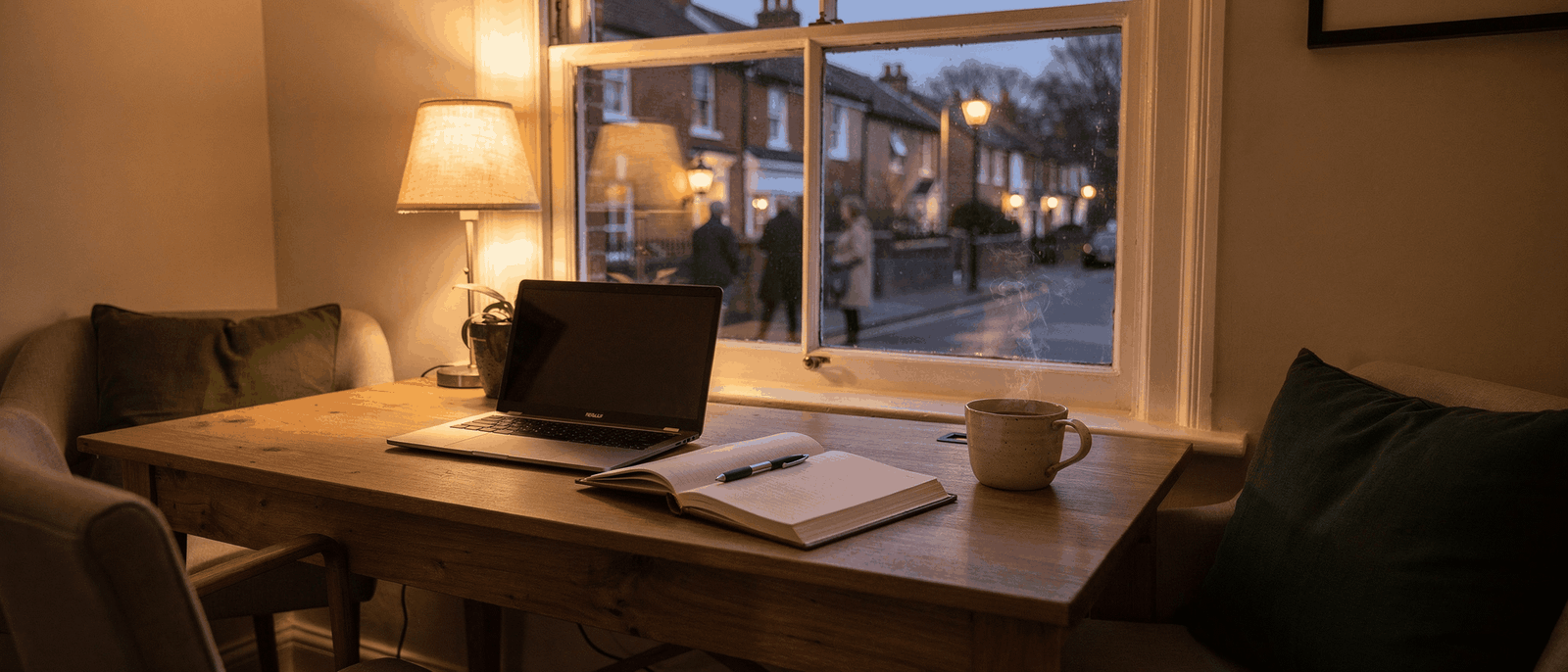
When the clocks go back, the UK returns to Greenwich Mean Time. GOV.UK explains that British Summer Time brings more daylight in the evenings and less in the mornings, so after the change the pattern flips. For someone who already works at home, a darker early evening can make staying in the easy default, because there is no office door to walk out of.
A 2023 report for the APPG on Tackling Loneliness, with the British Red Cross, found 19% of workers were working at home, up from 11% before the pandemic, and 24% were hybrid working, up from 13%. That is a survey result, not a current national figure. The picture is mixed: a British Red Cross survey of 2,000 people in August and September 2022, reported by People Management, found 43% of home or hybrid workers felt closer to colleagues and 26% more distant. NHS Every Mind Matters adds that everyone is affected by loneliness at times.
Why small, repeatable plans beat big ones
What the NHS says about connecting
The NHS says evidence suggests there are 5 steps you can take to improve your mental health and wellbeing, and the first is to connect with other people. It adds that good relationships can help you build a sense of belonging and self-worth, share positive experiences, and give and receive emotional support. That is not a promise that seeing people fixes anything. It is a reason to keep a few small plans going.
One caution from the same page: do not rely on technology or social media alone, because it is easy to slip into only texting, messaging or emailing. Keep at least one plan in person, on a call or on video.

The tired-Tuesday test
Before a plan goes in the diary, ask one question: could I still do this on a tired, dark weekday evening? If yes, keep it. If not, do not drop it. Shrink it to its low-effort version instead. A long supper becomes a call over supper, and a long walk becomes a short loop. Every idea below comes with a version like this.
In the working day
A call or lunch with a colleague
The NHS lists lunch with a colleague among its ideas for connecting with other people. If your colleagues are not nearby, a regular lunchtime call does the same job: same day each week, eating while you talk.
If the day is too full for that, the low-effort version is this:
- Swap the lunch for a ten-minute voice or video catch-up
- Ask one question, then end the call when the ten minutes are up
A screen break with other people around
The NHS Every Mind Matters guide to working from home suggests short breaks of 5 to 10 minutes each hour. One of them could be outdoors, on a bench or a lap of the block where other people are around, with a hot drink in an insulated flask.
The low-effort version if you cannot face going out:
- Stand at the front door with the drink and watch the street
- Say hello to a neighbour if one passes
After work: a fixed weekly walk
A fixed weekly walk with a friend
The NHS working-from-home guide suggests using your own 'commute time' for exercising, reading or listening to music, and stopping work when the day ends. That end-of-day moment makes a handy cue for one fixed weekly walk.
Say it is Thursday at 5.30pm, same start point, one friend, back before supper. Choose a lit, familiar route.
The low-effort version is a ten-minute loop, or a phone call while you each walk.
After work: a craft, book or supper evening
A craft or book evening
Each person brings a project or a book. A library loan or a second-hand copy is the cheap route. You sit together and swap a few words rather than hosting anything.
The low-effort version:
- Sit together on a video call, each doing your own thing
- Stop after an hour, or when it stops being fun
A cosy supper at home
The NHS suggests setting a fixed time to eat dinner together. At home that can mean the same evening each fortnight, something simple in one pot, and lamps on rather than the big light.
The low-effort version:
- Eat your own suppers at the same time on a video call
- Keep the menu to one pot and keep the washing-up small
Low-pressure starters

Say hello first
Mind says you do not need to rush, and suggests starting small by chatting to people in everyday life, such as a cashier in a local shop or a neighbour. A neighbour opener, to adapt: 'Hi, I work from home so I'm around in the day. Have you lived here long?'
Try a group or class, and ask to watch first
The NHS suggests joining a group or class around something you enjoy, and says you can ask to watch first if you are nervous. It also suggests places where you can be around other people, such as a park, cinema or café. A message to an organiser: 'Hello, I'm thinking of coming along but I'm a little nervous. Could I watch the first session before I join in?'
Invite a friend, and use groups as a way in
One line to a friend: 'I'm putting a walk in the diary for Thursday evenings. Fancy joining me this week?'
Mind also suggests a local social media group you can join from home; use it to find a first call or in-person plan.
Plan the month on one page
One fixed, one flexible, one fallback
Each month, write down three plans. Fixed: the same day and time every week, tied to your end-of-day cue. Flexible: one catch-up with no set day, arranged when diaries allow. Fallback: a call or short walk you can do if the others fall through.
Make sure at least the fixed plan is in person, on a call or on video, not messages alone, as the NHS advises.
A freelancer's month, as a hypothetical
Say a freelancer picks a Thursday walk with a friend as the fixed plan, lunch with a former colleague as the flexible plan, and a call to a sibling as the fallback. If Thursday is rained off, the call happens that evening and the walk returns next week. Nothing is lost; the plan simply moves.

Put it in the calendar
Enter the fixed plan as a repeating weekly event. Give the flexible plan a reminder to suggest a date. Keep the fallback somewhere you will see it on a bad day. At the end of the month, keep, shrink or swap anything that failed the tired-Tuesday test.
If a plan falls through, and where to find more support
Missing a plan is normal
Plans fall through. Someone is ill, the weather turns, or you are simply spent. Swap in the fallback, say you will try again next week, and carry on.
If loneliness is affecting your life, the NHS says you can speak to your GP about social prescribing, where a link worker may help find local support and activities. The NHS 'Feeling lonely' page and Mind's page on managing loneliness are the places to start.
FAQ
What if I am an introvert or tired after work?
Use the tired-Tuesday test. If a plan feels too much on a dark weekday, shrink it: a ten-minute call instead of an evening out, or a short loop instead of a long walk. Small and repeated is the aim, not a full diary.
Do messages and group chats count?
They can be a starting point, and Mind suggests a local social media group you can join at home. But the NHS advises not to rely on technology or social media alone, so keep at least one weekly plan in person, on a call or on video.
When should I look for more support?
If loneliness is affecting your life, the NHS 'Feeling lonely' page and Mind's page on managing loneliness are the places to start.
Verdict
Before the clocks go back on Sunday 25 October, pick three plans: one fixed weekly plan, one flexible plan and one fallback, and keep only what passes the tired-Tuesday test. The biggest reservation is that none of this is a cure-all, and any plan is optional; the NHS says connecting with others could help, not that it fixes things. Next step: put the first plan in your diary and send the invitation today.


