



Top 10 Best Monitor Arms UK…

Under-Desk Walking Pads UK 2026: 3…

How to Reduce Screen Glare Indoors…

Garden Office Setups for Remote Workers:…

Wellness Gadgets for Home Workers (2026):…

Top 10 Best Wearables for Wellness…

Black Friday Desk Comfort Buys: What…

The Best Desk Stretches for Busy…

Top 10 Ergonomic Office Chairs for…

Sunrise Alarm Clocks Compared: Are They…

Fitbit Edge vs Fitbit Air vs…

Soup Maker vs Saucepan: Which Suits…
To keep a home office cool in summer, stop the heat getting in before you try to cool the room: shut the blinds on sunny windows, open them at night, and move your working hours earlier. Then add a quiet fan, which costs pennies a day, and keep a portable air conditioner for rooms that still overheat.
Checked: November 2026. Prices were read on UK retailer pages on 28 November 2026, out of season, so recheck them before summer.
Quick Overview
- Before 9am, shade sunny windows with blinds.
- A desk fan costs about 7p a workday.
- Quietest pick for calls: Duux Whisper Flex 2.
- Air conditioning: about £1.70 a day at full power.
- Dizzy or sick? Stop and check NHS advice.

Quick Verdict: How to Keep a Home Office Cool in Summer
For most home workers, a block-out blind on a sun-facing window and a quiet fan solve most summer days. The Bush 12-inch desk fan at £20 is the cheap start, and the Duux Whisper Flex 2 at £179.99 is the pick if you take many video calls. Only buy a portable air conditioner, such as the De'Longhi Pinguino Compact ES72 at £349.99, if the room stays too hot. The Duux and the De'Longhi were both out of stock in November.
Why a Home Office Gets Hotter Than a Workplace Office
Most home offices were never designed as offices. A spare bedroom, loft or box room may face the sun, with one small window and no air conditioning. You are in it all day, through the hottest afternoon hours, with a laptop, monitor and chargers all adding heat.
There is no commute break either. At home it is easy to sit in the same warm room from 9 to 5.
Step 1: Stop the Heat Getting In
Close the blinds before the sun reaches the window
Shut blinds or curtains on sun-facing windows in the morning, before the room warms up. A block-out blind such as the IKEA TRETUR (£45 for a 100x195cm blind) stops light reaching the room. IKEA's page says it blocks light but makes no claim about heat, so treat any cooling effect as a bonus, not a promise.
Open up when the air outside is cooler
Open windows in the evening and early morning when the air outside is cooler than inside, and close them again once it warms up. In a home office you can do this around your workday, which an office worker cannot.
Move the desk away from the window
Sitting in direct sun makes a warm room feel hotter, and it adds screen glare. Turn the desk side-on to the window if the room allows it.
Step 2: Change How You Work, Not Just the Room
Working from home gives you one big advantage: you can often choose when and where you work.
- Start earlier and do focused work before the afternoon peak.
- Move to the coolest room in the house for the afternoon, often a north-facing room or the ground floor.
- Shut down the second screen and unplug chargers you are not using.
- Put your laptop on a stand so air can move under it. Our laptop stand guide compares options.
- Wear light, loose clothing and keep water on the desk.
If you are employed, talk to your manager. HSE says there is no maximum workplace temperature, but employers must provide a reasonable temperature and assess the risks of heat. Ask whether your hours can shift in a heatwave.
Step 3: Choose a Fan or Cooler for a Home Workday
Prices checked on 28 November 2026 on each retailer's page. Running costs use the Ofgem price cap rate of 26.32p per kWh for October to December 2026, for an 8-hour workday.
| Product | Best for | Power | Price | Cost per 8-hour day |
|---|---|---|---|---|
| Bush White Desk Fan, 12 Inch | A cheap start | 35W | £20.00 (Argos) | About 7p |
| MeacoFan 1056 Air Circulator | Moving air across a whole room | 24W | £99.99 (Meaco) | About 5p |
| Duux Whisper Flex 2 Smart Fan | Video calls | Up to 19W | £179.99 (Duux, sold out) | Up to about 4p |
| De'Longhi Pinguino Compact ES72 | A room that stays too hot | 808W listed | £349.99 (De'Longhi, out of stock) | Up to about £1.70 |
| IKEA TRETUR block-out roller blind | Keeping sun out | None | £45 for 100x195cm (IKEA) | Nothing |
The air conditioner figure assumes it runs at its listed power for all 8 hours. Real use is usually lower because it cycles on and off, so treat it as the top end.
The Picks for a Cooler Home Office
Bush White Desk Fan, 12 Inch: Best for a Cheap Start
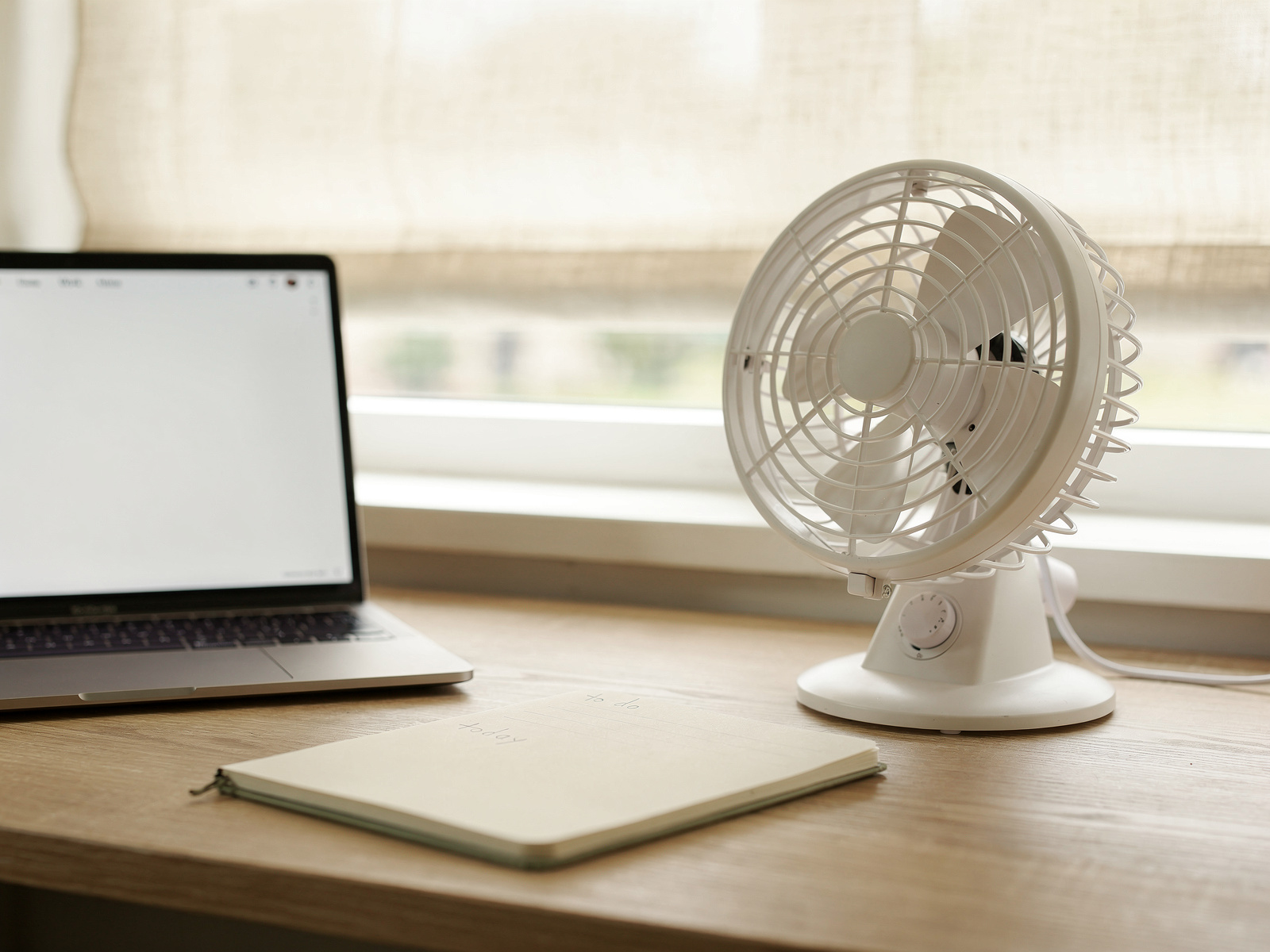
Argos lists the Bush White Desk Fan (12 inch) at £20.00, with a manufacturer's 1-year guarantee. It has three speeds plus variable speed, and oscillates and tilts. Argos's Q&A says it uses 35 watts on its highest setting. A desk fan aimed at you rather than at the whole room is often all a home worker needs on a warm day, and it is cheap enough to keep as a spare.
Bush White Desk Fan, 12 Inch at a glance
Best for: a first fan for a desk in a spare room. Watch out for: Argos did not list a noise figure, so it may be audible on calls.
MeacoFan 1056 Air Circulator: Best for Moving Air Across a Whole Room
Meaco lists the MeacoFan 1056 Air Circulator at £99.99, with a 2-year warranty that can be extended to 5 years. It uses 24 watts, starts at 29dB, and has a 1 to 12-hour timer and a magnetic remote. An air circulator moves air around the whole room rather than at one spot, which helps in a box room or loft office. Best for: a home office you use all day. Watch out for: stock changes, so check before summer.
Duux Whisper Flex 2: Best for Video Calls
Duux lists the Whisper Flex 2 Smart fan in black at £179.99 on its UK site, where it showed as sold out in November. It uses 1 to 19 watts, has 30 speeds, a remote control, and horizontal and vertical oscillation, and Duux lists noise from 13dB. That low noise matters for home workers on calls all day, because a loud fan is picked up by laptop microphones and headsets.

Duux Whisper Flex 2 at a glance
Best for: people who spend much of the working day on Teams or Zoom. Watch out for: it was sold out in November, and it costs about nine times the Bush desk fan.
De'Longhi Pinguino Compact ES72: Best for a Room That Stays Too Hot
De'Longhi lists the Pinguino Compact portable air conditioner (PACES72YOUNG) on its UK site at £349.99, down from £439.99, with a 2-year warranty. It gives a cooling capacity of 8,300 BTU an hour (2.1kW) and an 808W input power, and mentions a remote control, a dehumidifying function and castor wheels. It lists noise from 47 to 52dB. It needs its hose venting through a window. Best for: a small, sun-facing home office that overheats even with the blinds down. Watch out for: out of stock on De'Longhi's site in November, so check again before summer.
IKEA TRETUR Block-Out Roller Blind: Best for Keeping Sun Out
IKEA lists the TRETUR block-out roller blind in white at £45 for 100x195cm, with other widths available. It is cordless and IKEA says the fabric blocks out all light. Keeping direct sun off the glass is one of the very cheapest ways to stop a home office warming up, and it also cuts screen glare on your laptop and monitor.
IKEA TRETUR Block-Out Roller Blind at a glance
Best for: sun-facing spare rooms and bedrooms used as offices. Watch out for: IKEA makes no claim about heat, and you need to measure your window first.

Worked Example: Fan or Air Conditioner for a Summer of Home Working
Say you work from home 20 days in a hot spell. At 26.32p per kWh:
- A 35W fan for 8 hours a day uses 0.28kWh, about 7p a day, or about £1.47 for 20 days.
- The 808W Pinguino at full power for 8 hours uses 6.46kWh, about £1.70 a day, or about £34 for 20 days.
So a fan costs about 4% of what an air conditioner can. Summer 2027 rates may differ from the October to December 2026 cap, so recheck before you buy.
Cooling Mistakes Home Workers Make
The biggest mistake is opening every window on a hot afternoon, when the air outside is often hotter than inside. Open up in the evening instead.
The second is buying a portable air conditioner first. It costs £349.99 here, uses far more power than a fan and needs a window for its hose. Try blinds, earlier hours and a fan first.
The third is ignoring noise. A fan that drowns out your voice on calls will end up switched off.
A Hot-Day Checklist for Home Workers
Use this on the morning a hot day is forecast.
- Before 9am: open windows while the air is cool, then close them and lower the blinds on sunny sides.
- Plan the day: put calls and focused work in the morning, and admin in the afternoon.
- Check your room: if the office faces the sun, find a cooler room for the afternoon and test the Wi-Fi there first.
- Set up the fan: point it at you, away from your laptop microphone.
- Cut heat at the desk: switch off the second screen and spare chargers, and raise the laptop on a stand.
- After work: shut the laptop, open the windows once it is cooler outside, and leave the room to cool overnight.
When to Stop Working in the Heat
Heat can affect anyone, and home workers alone in a hot room may not notice it building up. Take breaks somewhere cooler, drink water through the day, and stop if you feel dizzy or sick. Confusion can be a sign of heatstroke: call 999. The NHS heat exhaustion and heatstroke advice lists the signs and when to get help. NHS advice says electric fans can help if the temperature is below 35 degrees. This guide is not medical advice.
Sources
Official guidance and product pages, read on 28 November 2026. Prices and stock change, so check before you buy.
- Ofgem: price cap changes, October to December 2026
- HSE: workplace temperature, what the law says
- NHS: heat exhaustion and heatstroke
- NHS: how to cope in hot weather
- Bush 12-inch desk fan at Argos
- MeacoFan 1056 at Meaco
- Duux Whisper Flex 2 at Duux UK
- Pinguino Compact ES72 at De'Longhi
- TRETUR block-out blind at IKEA
FAQ
What temperature is too hot to work from home?
There is no legal maximum. HSE says employers must provide a reasonable temperature and assess heat as a risk. Its page does not single out home workers, so if your home office is uncomfortable, tell your manager and ask about changing your hours.
Is a fan or a portable air conditioner better for a home office?
A fan is cheaper to buy and run, at about 4p to 7p for an 8-hour day here. A portable air conditioner lowers the room temperature, but costs more, is louder and needs a window for its hose. Start with a fan.
How do I keep a home office cool without air conditioning?
Close blinds on sun-facing windows in the morning, open windows when it is cooler outside, work earlier, move to a cooler room in the afternoon and use a fan. Switching off devices you are not using also helps a little.
Will a fan be too loud for video calls?
Some will. Duux lists the Whisper Flex 2 from 13dB, and Meaco lists its 1056 from 29dB. Point the fan away from your laptop microphone and test it on a call before a meeting.
Final Verdict
Final Verdict
To keep a home office cool in summer, start free: blinds down on sunny mornings, windows open in the cool evening, and focused work before the afternoon heat. Then buy the Bush 12-inch desk fan at £20, or the Duux Whisper Flex 2 at £179.99, sold out in November, if you are on calls all day. Keep the De'Longhi Pinguino Compact ES72 for a small room that still overheats. The main reservation is that prices were checked in November, so confirm them before summer.