



Meta One Explained: Is the Subscription…

Lifesum Review UK: Is Premium Worth…

Plaud One Explained: Can AI Earbuds…

Garmin CIRQA Review: Is Screen-Free Tracking…

Namecheap vs Dynadot

Garden Gatherings – Summer Is The…

Convertkit Vs Beehiiv

Portable Outdoor Speakers for Garden Offices

Bluehost vs Siteground

Outdoor WiFi Extenders For Garden Offices

Namecheap review

Portable Pools For Home Workers This…

Cloudways Vs WP Engine

Best Polarised Sunglasses

Dropshipping Explained

Best Office Desks For Small Spaces

Email Subject Lines That Improve Open…

Cooling A Garden Office During Summer

Kajabi Review

Best Portable Power Stations For Garden…
A solar panel that plugs into a household socket sounds like an unusually simple answer to expensive electricity. Since 27 August 2026, compliant systems have a route into homes across Great Britain. But permission to use a product, a suitable place to install it and worthwhile savings are three different things. Here is how to work out whether this smaller form of solar makes sense for your home.
Why Plug-In Solar Is Suddenly Being Discussed
What Plug-In Solar Actually Is
What The New Rules Allow
How Much Electricity Could It Produce?
Will It Really Reduce Electricity Bills?
Current Great Britain Products And Prices
The Practical Checks Before You Buy
Plug-In Solar Versus Conventional Rooftop Solar
Who May Benefit—and Who Should Wait?
A Genuine Money Saver Or Mostly Hype?
Frequently Asked Questions
Final Verdict
Quick Overview
Quick Overview
The new route covers compliant systems in England, Scotland and Wales, not Northern Ireland.
One device per household is currently allowed, with no more than 800W AC output.
Sunny positioning and electricity used during daylight matter more than the headline panel rating.
Budget for the complete setup, including any electrical checks, mounting extras and delivery.
Surplus electricity is not automatically paid for; confirm a specific export arrangement before counting it as income.
Article Section
The change is real: the government's announcement identifies 27 August as the start of legal use across Great Britain for compliant plug-in solar. It opens a smaller purchasing decision than commissioning a rooftop array, which may appeal to renters, flat residents and households unable to commit several thousand pounds. Government announcement, checked 20 September 2026.
The opportunity is narrower than some headlines suggest. A flat without suitable outside space does not gain a usable installation location because the law changes. Nor does a tenant gain permission to attach equipment to a shared building. The appeal is greater access to generation where the practical conditions work—not universal access to sharply lower bills.
For the wider workspace plan, see our Best Garden Office Setups. Decide where you can work comfortably and where the panels can safely receive sunlight as two parts of the same space plan.
Article Section
A Small Generator Connected To Your Home
A complete kit combines photovoltaic panels, a microinverter, approved connecting cable and plug, and a suitable mounting system. Sunlight produces direct current, or DC, at the panel. The microinverter converts it into alternating current, or AC, for the home's electrical system. Some kits provide app monitoring to show generation.
It works alongside the grid. If your appliances need more power than the panel supplies, the remaining electricity comes from your normal supply. If generation exceeds demand, the surplus can flow out to the network. The socket is a connection point, not a battery holding today's sunshine for tonight. Energy Saving Trust explanation, checked 20 September 2026.

The Complete Kit Matters
A panel sold for camping is not automatically a mains-connected solar device. Likewise, a microinverter advertised as suitable for Europe does not establish that a collection of separately purchased components meets Britain's requirements. Buy and check the complete system, including its approved configuration and installation instructions.
The government's Interim Product Specification sets requirements for plug-in solar devices; it does not create a general permission to feed electricity into a socket with improvised equipment. Retain the model details, compliance documents and invoice so you can identify exactly what has been supplied. Government specification and response, checked 20 September 2026.
If you want stored power for individual devices away from a suitable mains connection, our Best Portable Power Stations For Garden Offices guide covers a different product category. It is not a list of compliant grid-connected solar kits, and a portable power station must not be improvised into a supply feeding a household socket.

Article Section
The route applies in England, Scotland and Wales. Northern Ireland has separate regulations and is not included in this change. Compliant devices are limited to 800W maximum AC output, and the current household rule is one device—even if that device contains two panels. Do not interpret two spare sockets as permission to connect two kits. Current consumer guidance, checked 20 September 2026.
You must register the plug-in solar installation through the relevant network-registration process so your Distribution Network Operator, or DNO, is notified. This is the company responsible for local electricity cables, rather than necessarily the supplier sending your bill. Current guidance is not completely consistent on timing: G98 notification guidance commonly refers to notification within 28 days of commissioning, while Energy Saving Trust's current consumer guide says registration is required before use. The safest practical approach is to complete registration as part of installation, before using the device, rather than leaving it until later. Follow the instructions for your exact kit and DNO. Energy Saving Trust registration guidance, checked 20 September 2026 and Welsh Government notification guidance, checked 20 September 2026.
Plug-in batteries are outside the current product route. An existing rooftop array or installed battery also needs separate consideration: ask the original installer and DNO about the combined installation before adding anything. This is not an automatic ban on homes with rooftop solar, but neither should the extra generator be treated as irrelevant to the existing connection arrangements.
Article Section
Rated Power Is Not An All-Day Promise
Watts describe power at a moment in time; kilowatt-hours describe energy accumulated over time. A panel's labelled capacity does not mean it produces that amount continuously. Direction, tilt, geographical location, shade, clouds and season all influence output. A bright summer afternoon is not a fair stand-in for an entire year.
The government says a kit could provide up to 20% of an average home's electricity use. Treat that as an upper illustrative claim, not your household forecast or a guaranteed bill reduction. Some generated electricity may arrive when you cannot use it, and your consumption may be very different from the household assumed in a headline.

Shade And Winter Change The Calculation
A clear south-facing position can be promising, but the usable space matters more than the compass direction alone. A neighbouring building, fence or tree can shade the panel during productive hours. Look at the proposed position at several times of day and consider how the sun's lower winter path changes it.
Energy Saving Trust models around 700kWh annually for its 800W example, using an unshaded south-facing installation in Manchester at a 30-degree angle. That is a defined scenario, not a prediction for every garden. Ask for a location-specific estimate and understand its assumptions before attaching a payback figure to it. Generation assumptions, checked 20 September 2026.
An outdoor desk may need shade even when the solar panel needs clear sunlight. Our Outdoor Laptop Screens And Anti-Glare guide can help you plan the working position separately from the generating position.

Article Section
Daytime Use Is The Strongest Starting Point
The clearest saving comes from replacing electricity you would otherwise buy at that moment. Fridges, routers and a home office create daytime demand, although their loads vary. Moving an ordinary appliance cycle into daylight may help, provided that suits your routine and the appliance's safe-use instructions.
Do not run unnecessary appliances simply to use the generation. The aim is to reduce purchased electricity for things you already need. A large appliance can also draw more than a small solar kit produces; using it on a sunny day does not mean its entire cycle is covered by solar.
For a garden workspace, include the router or extender in your daytime equipment list and plan connectivity alongside power. See Outdoor WiFi Extenders For Garden Offices. A reliable connection is a separate requirement from having electricity available.

Evening Demand And Surplus Are Different
A household that is mostly out during daylight may use less of the generation directly. Without permitted plug-in storage under this route, the day's surplus cannot simply be kept for the evening through an added plug-in battery. It may leave the property without earning anything.
There is now an important conditional exception: Octopus describes export access for households it supplies that buy their kit directly from Octopus, have a working smart meter and complete the ENA registration and DNO approval process. Kits bought elsewhere are excluded from its offer. If another company supplies your electricity, Octopus says to arrange export with that supplier; acceptance is not guaranteed. Octopus also explicitly excludes plug-in solar from its SEG tariffs. Confirm eligibility and the tariff before budgeting for payments. This is not automatic SEG entitlement. Octopus export conditions, checked 20 September 2026.

Strong daytime use
Existing demand overlaps with generation. More opportunity to avoid buying electricity.
Mostly evening use
More generation may become surplus. Check export eligibility; do not assume all output saves the retail rate.
Shaded or poorly positioned panels
Less energy is generated in the first place. Resolve the location before spending money.
Energy Saving Trust's model estimates roughly £100 a year for a household home during the day and £70 for one out during the day. It assumes 2,500kWh annual household use and electricity at 24.7p/kWh. These are modelling inputs, not a quote for your tariff or a guarantee. A useful comparison needs both expected generation and the share you will actually use.
Article Section
Prices and order information below were checked on 20 September 2026. They are advertised offers, not a guarantee of stock at your postcode. This is a researched comparison; we have not tested the equipment.
Four-Product Price Snapshot
Octopus single: 460W panel capacity — £450.
Octopus dual: 920W panel capacity, from two 460W panels — £650.
UKSOL Compact: 460W panel capacity — £599 collection / £699 delivered.
UKSOL Duo: 890W panel capacity, from two 445W panels — £899 collection / £999 delivered.
These are panel-capacity figures, not permission to exceed 800W AC output. The complete device's microinverter must keep output within that limit. Compare mounting, delivery and any electrical work as well as the advertised price.
Octopus Plug-In Solar Bundles
Octopus lists a single 460W-panel bundle at £450 and a two-panel bundle at £650. Its explainer confirms those prices; check the full checkout and chosen mounting option before paying. Octopus product explainer, checked 20 September 2026.
The live ordering page's delivery section, checked on 20 September 2026, says orders placed from 11 September onwards are expected at the end of October 2026. The same page still carries an end-of-September headline higher up; the order-date-specific delivery section is more useful for new buyers. Confirm the estimate for your order before paying. The page also states ENA compliance. Ask for the exact model/register reference with your order. Current delivery information, checked 20 September 2026.
UKSOL Compact 460W Ground-Mount Kit
UKSOL's direct listing offers £599 click-and-collect or £699 with two-person delivery. It contains one 460W panel and an 800W microinverter; the inverter's ceiling does not turn that panel into an 800W generator. Its ground stand is explicitly unsuitable for balcony mounting, and ballast is not included.
The practical comparison is the delivered, ready-to-site cost. Collection only saves money if transport and handling are feasible. UKSOL Compact listing and delivery options, checked 20 September 2026.
UKSOL Duo 890W Ground-Mount Kit
The Duo is listed at £899 click-and-collect or £999 with two-person delivery. Two 445W panels provide 890W of labelled panel capacity, while the microinverter caps AC output at 800W. This distinction explains why a compliant kit can have a panel total above the output limit.
It is ground-mount only, with ballast excluded. UKSOL announced its first complete-kit compliance listing in August; check the precise supplied variant against the register. Duo listing, checked 20 September 2026.
Compare The Actual Configuration
UKSOL's wider store also advertises upcoming hybrid-mount products. Those are different configurations, not permission to put the ground-mounted kits on a wall. Similarly, “battery compatible” marketing does not override the current exclusion of plug-in batteries.
EcoFlow European solar-and-battery products are not included as verified British alternatives here: the exact compliant Great Britain product was not established. A familiar brand name or UK affiliate programme cannot substitute for checking the product itself. UKSOL range and announcements, checked 20 September 2026.
Article Section
Permissions, Position And Mounting
Start with written permission where required from your landlord, freeholder or building manager. Planning and building restrictions still apply, and differ with location and property. A listed building, shared balcony or conservation area deserves particular attention. Do not assume permission granted for a freestanding garden installation covers a façade attachment.
Check the manufacturer's permitted mounting locations and the structure's ability to take both weight and wind loading. Leave doors, escape routes and walkways clear. Think about moving house too: removable equipment is only useful at the next address if there is another suitable, permitted location. Check insurance requirements where appropriate. Pre-purchase checklist, checked 20 September 2026.

Electrics, Cable Routes And Documentation
Electrical Safety First recommends an assessment by a competent registered electrician before purchase or use, especially where wiring and protective devices are uncertain. Its current recommendation is at least a Type A bidirectional RCD protecting the relevant circuit. Homes with Type AC RCDs should not use plug-in solar until that circuit's protection has been upgraded to at least Type A bidirectional protection. Ask the electrician to assess and carry out any necessary work; do not alter the consumer unit yourself.
Use the specified suitable socket and cable arrangement. Never connect through an extension lead, cable reel, multiway adaptor, travel adaptor or plug-in RCD adaptor. Avoid pinched cables and trip hazards. Keep compliance records and complete network registration as part of installation, before use. A DIY product does not certify the home's wiring or your mounting arrangement. Electrical Safety First advice, checked 20 September 2026.

Article Section
Both convert sunlight into household electricity, but their scale and purchasing decisions differ. A small kit is not an equivalent replacement for a roof-sized installation.
Plug-in solar
Initial price: Current examples start at £450 before any site-specific extras.
Typical scale: Small device, capped at 800W AC.
Installation: May be self-assembled; electrical or mounting work can still need a professional.
Portability: Can potentially move with you.
Battery: Plug-in battery excluded from this route.
Export payments: Conditional and supplier-specific; not automatic.
Annual generation: Smaller, strongly dependent on site.
Best fit: Suitable outdoor space, smaller budget, daytime demand.
Conventional rooftop solar
Initial price: Usually several thousand pounds; obtain a property-specific quote.
Typical scale: Multi-panel array sized for the property.
Installation: Professional design, mounting and hardwired connection.
Portability: Normally a permanent property installation.
Battery: Compatible professionally installed storage may be specified.
Export payments: Established tariff routes, subject to certification and eligibility.
Annual generation: Usually substantially greater, dependent on array and roof.
Best fit: Suitable roof, permissions and budget for a larger project.
The broad distinction is supported by Energy Saving Trust's comparison, checked 20 September 2026. Compare quotes on the same basis: including a large battery in the rooftop price but none in the plug-in price is not a like-for-like equipment comparison.
Article Section
A Reasonable First Step
Renters with written permission, home workers using electricity during daylight and homeowners with a sunny, usable patio may find the smaller commitment appealing. The strongest case combines a straightforward installation, modest additional costs and enough daytime demand to use a useful share of the output.
It can also be a way to learn how generation varies before considering a larger project. That learning has value, but keep it separate from the financial return: enjoying the technology does not make every installation pay for itself quickly.
If the workspace becomes uncomfortable in sunshine, see Cooling A Garden Office During Summer. Plan shade and ventilation as well as any powered cooling; do not assume a small solar kit will cover the cooling equipment you choose.
A Purchase Worth Delaying
Wait if permissions remain unresolved, the only location is heavily shaded, the mounting is questionable or there is no suitable electrical connection. Existing solar complications also need resolving before purchase. For a household with little daytime demand, export terms may materially change the decision.
Do not buy on an expectation of powering the whole home, obtaining blackout backup or adding an ordinary plug-in battery later. None of those follows from the current small-generation route. Waiting for a better-fitting product is more sensible than adapting the wrong kit to your property.
Article Section
The market change is genuine; the shortcut from “legal” to “large savings” is the weak part. Work from your total delivered and installed cost, then estimate annual electricity savings and only confirmed export income. Include any electrical upgrade and mounting expense rather than treating the box price as the whole investment.
Simple payback is total cost divided by annual net benefit. That calculation remains an estimate because generation, tariffs, household habits and future repairs can change. Ask what happens if the saving is lower than expected. A purchase should still feel manageable without relying on the most optimistic year in a sales example.
If solar is one part of a larger workspace project, our How To Create A Budget Garden Office guide helps frame the wider spending decision. Keep the solar cost and expected saving visible within the total project budget.
Article Section
Are plug-in solar panels now legal in the UK?
Compliant devices have been permitted in Great Britain since 27 August 2026. That means England, Scotland and Wales; Northern Ireland is not included in this change.
Do I need an electrician?
Not necessarily to assemble a suitable complete kit, but electrical suitability still matters. Electrical Safety First recommends a professional assessment before purchase or use. New sockets, protective-device changes or other electrical work should be handled appropriately.
Can I use them in a rented property?
Potentially, with the required permissions and a suitable installation. Obtain written agreement for the actual position and mounting method, rather than relying on a general conversation about solar.
Can I connect a battery?
Not under the current plug-in-solar-only route. Do not treat a manufacturer's compatibility claim as permission to add mains-connected plug-in storage.
Will I be paid for surplus electricity?
Only with a confirmed eligible arrangement. Octopus describes a conditional route for its own kits and qualifying customers; it is not a universal offer for every device. Otherwise, exported electricity may earn nothing.
Do I tell my supplier or the network operator?
Register through the relevant network process so the DNO is notified. Guidance differs between notification within 28 days and registration before use; complete registration as part of installation, before using the device, and follow your kit and DNO instructions. Speak to your supplier separately about any export tariff. They perform different roles.
Can I use more than one kit?
Current consumer guidance allows one device per household. One complete device may have multiple panels, but that is different from plugging in separate kits.
How quickly could it pay for itself?
There is no single reliable answer. Divide your full setup cost by a realistic annual net benefit and test a lower-saving scenario. Do not apply someone else's best-case generation to your own shaded garden.
Will it work during a power cut?
A normal grid-connected plug-in kit stops supplying electricity when the grid fails. It is not a backup power system. Octopus power-cut guidance, checked 20 September 2026.
Are ordinary European balcony kits legal in Britain?
Not automatically. Verify the exact complete product against the British specification and register. A European listing, ordinary plug adaptor or recognised brand name does not establish compliance.
Article Section
Plug-in solar is a significant development because it gives some households a smaller route into generation. For a suitable home with clear permissions, good positioning and useful daytime demand, it may offer a worthwhile reduction in purchased electricity.
The right decision starts with the property and the numbers, not the headline. Compare realistic savings with the complete delivered setup cost, verify the exact kit and confirm export terms separately. If those checks do not add up, waiting is a perfectly sensible outcome.
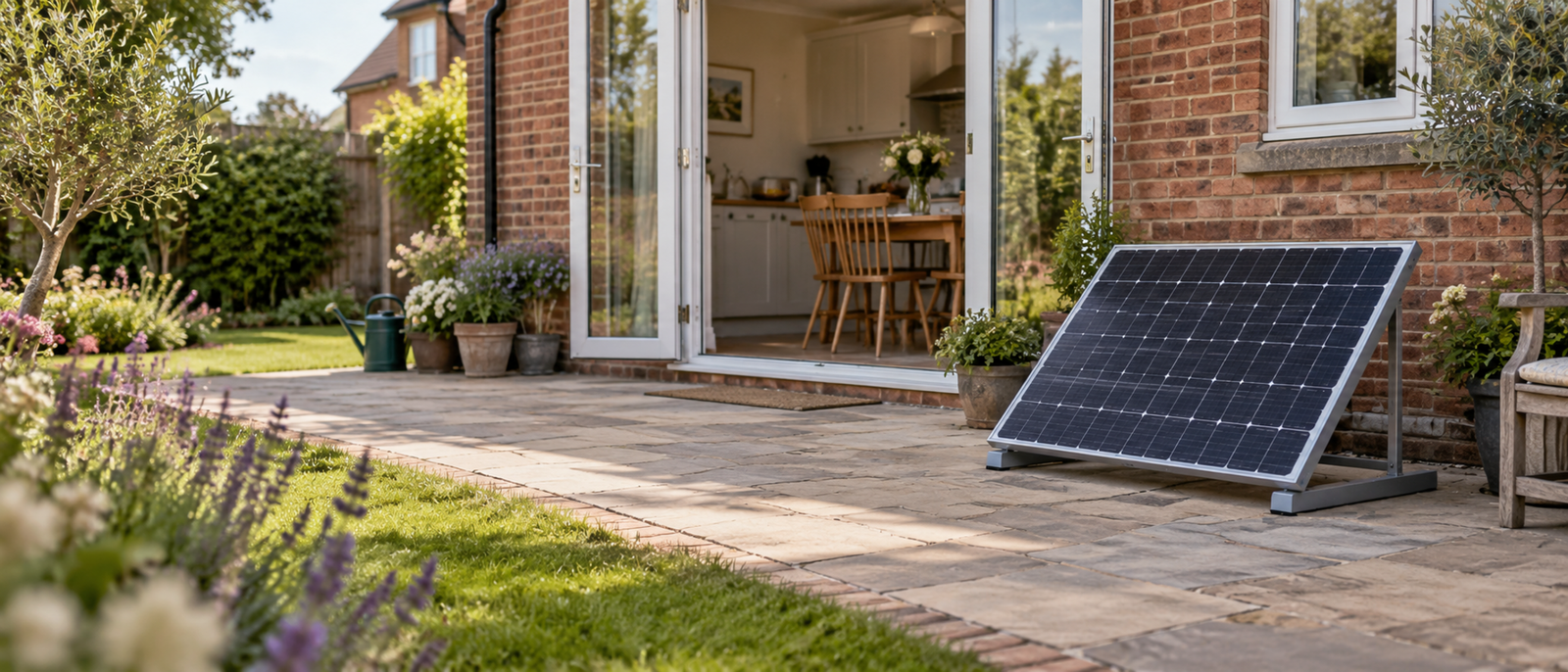
Images are AI-generated illustrations, not installation diagrams or photographs of tested installations.
%%MHT_RELATED_LINKS_START%%
url: https://myhotips.com/blog-items/best-garden-office-setups-for-remote-workers/
slug: best-garden-office-setups-for-remote-workers
anchor: Best Garden Office Setups
reason: Supports the contextual garden workspace or power discussion; already linked in the article text.
family: healthy-home-work
chosen_style: chosen-only
panel_slot: related
link_bucket: cross-section
section:
panel:
priority: 1
url: https://myhotips.com/blog-items/best-portable-power-stations-for-garden-offices/
slug: best-portable-power-stations-for-garden-offices
anchor: Best Portable Power Stations For Garden Offices
reason: Supports the contextual garden workspace or power discussion; already linked in the article text.
family: healthy-home-work
chosen_style: chosen-only
panel_slot: related
link_bucket: cross-section
section:
panel:
priority: 2
url: https://myhotips.com/blog-items/outdoor-laptop-screens-and-anti-glare-setups-for-summer/
slug: outdoor-laptop-screens-and-anti-glare-setups-for-summer
anchor: Outdoor Laptop Screens And Anti-Glare
reason: Supports the contextual garden workspace or power discussion; already linked in the article text.
family: healthy-home-work
chosen_style: chosen-only
panel_slot: related
link_bucket: cross-section
section:
panel:
priority: 3
url: https://myhotips.com/blog-items/best-outdoor-wifi-extenders-for-garden-offices/
slug: best-outdoor-wifi-extenders-for-garden-offices
anchor: Outdoor WiFi Extenders For Garden Offices
reason: Supports the contextual garden workspace or power discussion; already linked in the article text.
family: healthy-home-work
chosen_style: chosen-only
panel_slot: related
link_bucket: cross-section
section:
panel:
priority: 4
url: https://myhotips.com/blog-items/cooling-a-garden-office-during-summer-heatwaves/
slug: cooling-a-garden-office-during-summer-heatwaves
anchor: Cooling A Garden Office During Summer
reason: Supports the contextual garden workspace or power discussion; already linked in the article text.
family: healthy-home-work
chosen_style: chosen-only
panel_slot: related
link_bucket: cross-section
section:
panel:
priority: 5
url: https://myhotips.com/blog-items/how-to-create-a-budget-garden-office/
slug: how-to-create-a-budget-garden-office
anchor: How To Create A Budget Garden Office
reason: Supports the contextual garden workspace or power discussion; already linked in the article text.
family: healthy-home-work
chosen_style: chosen-only
panel_slot: related
link_bucket: cross-section
section:
panel:
priority: 6
%%MHT_RELATED_LINKS_END%%






