



Host a Virtual Halloween Party: Audio,…

20 Minimalist Halloween Nail Ideas for…

Can Free Affinity Help You Build…

12 Lower-Sugar Halloween Treat Swaps Worth…

Can Hostinger AI Builder Launch a…

A 5-Step Screen-Free Autumn Reading Ritual…

Plug-In Solar Panels UK: Are They…

15 Last-Minute Zoom Halloween Costumes for…

Meta One Explained: Is the Subscription…

10 Low-Fuss Dog Halloween Ideas: Comfort…

Plaud One Explained: Can AI Earbuds…

9 Gothic Dinner Table Ideas for…

Namecheap vs Dynadot

7 UK Ghost Tours and How…

Convertkit Vs Beehiiv

Do You Really Need a £420…

Bluehost vs Siteground

15 Gentle Spooky Autumn Books to…

Namecheap review

How to Remove Halloween Face Paint…
An affiliate email funnel is not just a few random emails with product links dropped in like confetti at a wedding nobody wanted to attend.
A good funnel has a job. It helps someone understand a problem, trust your recommendation, compare the right options and decide whether a product genuinely suits them. That matters because affiliate income depends on relevance, timing and trust, not just how many links you can squeeze into a paragraph before the reader starts backing away slowly.
This blueprint is for creators, bloggers, newsletter writers and small site owners who want to use email more strategically. It is not about spamming your list, pushing products you would not use yourself or pretending every tool is “life-changing” because it pays commission.
The goal is simple: build an email funnel that introduces useful content, recommends affiliate products naturally and gives readers a reason to click without feeling like they have wandered into a digital market stall.
An affiliate email funnel usually works best when it starts with a specific reader problem.
The first emails should build context and trust before making stronger product recommendations.
Each email needs one clear purpose, not five competing calls to action.
Affiliate links should feel like useful next steps, not surprise traps.
Email platforms such as ConvertKit Creator Email Platform, ActiveCampaign, MailerLite Email Marketing and GetResponse Email Marketing can help manage sequences.
Good funnels need tracking, testing and clean list management.
The best affiliate funnels make money by being genuinely useful first.

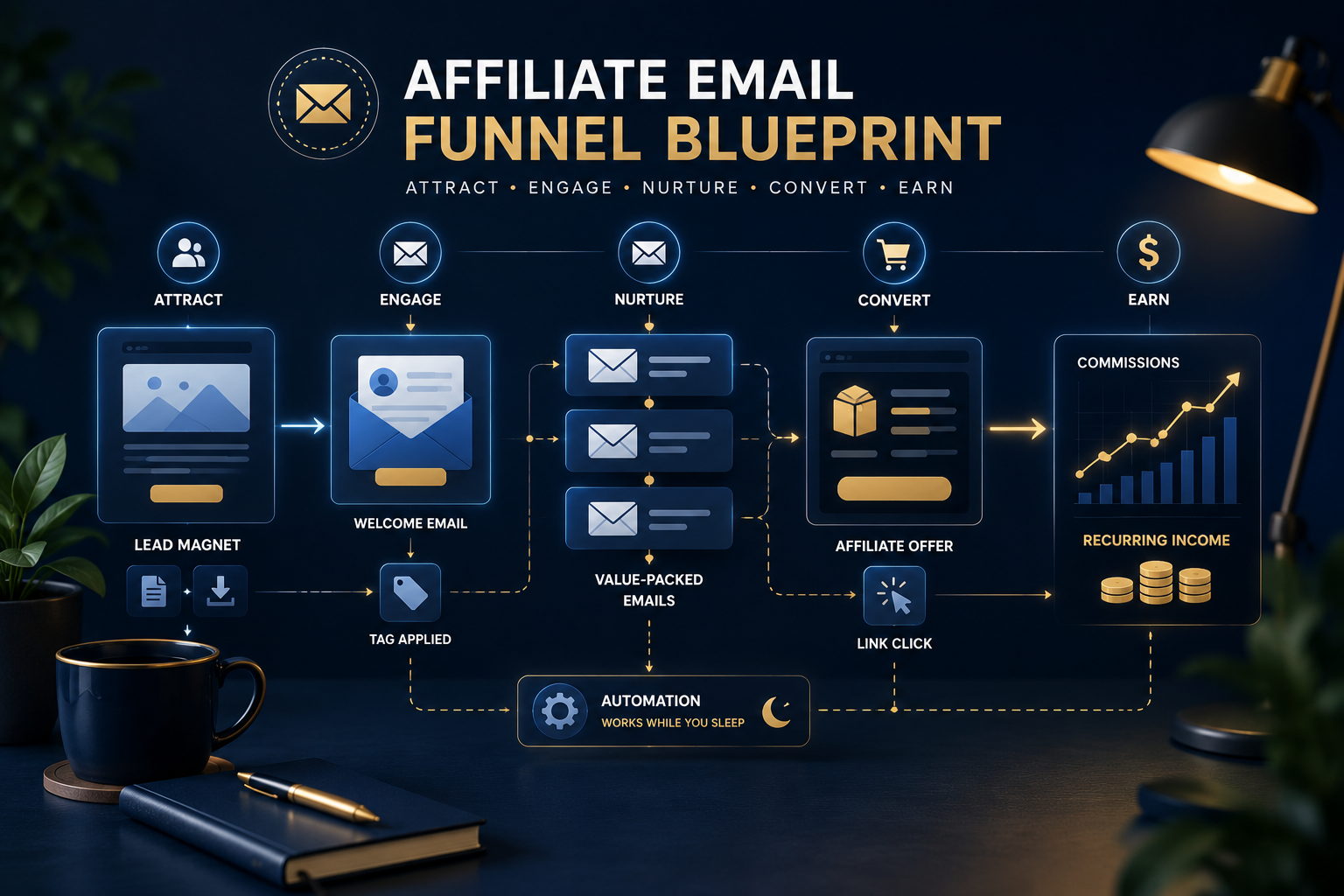
The basic affiliate email funnel structure
Email 1: Welcome and expectation setting
The first email should confirm why the reader joined and what they will get next. Keep it warm, useful and specific. Do not immediately launch into a hard sell unless the reader signed up for a product deal or buying guide.
A good welcome email can point to a helpful article, introduce your angle and explain what kind of recommendations you share. This is where trust starts, so avoid sounding like a commission calculator in human form.
Email 2: Problem education
The second email should help the reader understand the problem more clearly. For example, if your funnel is about starting email marketing, explain why relying only on social media is risky and why owned audience building matters.
This email can mention a tool category, but it should not feel like a product pitch yet. The aim is to make the reader feel understood, not cornered.
Email 3: Useful solution framework
The third email should give the reader a simple framework for solving the problem. This might be a checklist, setup method, decision guide or beginner-friendly blueprint.
At this point, you can naturally mention relevant tools. For example, someone building a creator email system might compare ConvertKit Creator Email Platform with MailerLite Email Marketing, depending on whether they care more about creator workflows or simplicity.
Email 4: Product recommendation
This is where the main affiliate recommendation belongs. The email should explain who the product suits, what problem it solves and why you are recommending it.
Keep the recommendation specific. “This tool is great” is weak. “This works well if you want simple landing pages, email sequences and creator-focused subscriber tagging” is stronger. Specificity sells better than hype because it helps the right person recognise themselves.
Email 5: Objection handling
Readers often hesitate for good reasons. They may worry about cost, complexity, time, switching tools or whether they are “ready” yet.
This email should answer those concerns honestly. If a product is too advanced for beginners, say so. If a cheaper option may be enough, say that too. Trust compounds. Over-selling may get a click today, but it can damage the list tomorrow.
Email 6: Comparison or alternative route
A comparison email helps readers choose without feeling pushed. You might explain when ActiveCampaign makes sense over MailerLite Email Marketing, or when GetResponse Email Marketing is worth considering for broader funnel features.
This email works because it gives the reader agency. You are not saying “buy this or else.” You are helping them make a better decision.
Email 7: Final reminder and next step
The final email should bring the sequence together. Recap the problem, the useful next step and who the recommendation suits.
Do not fake urgency unless there is a real deadline. False countdowns are not strategy; they are theatre with worse lighting. A clear final nudge is enough: remind the reader what they wanted to solve and show them the next practical move.
What makes this funnel work
The structure works because it does not ask for the sale before the reader understands why the recommendation matters. That is the mistake many affiliate funnels make. They jump straight from “hello” to “buy this,” then wonder why people do not click.
A better funnel behaves more like a helpful conversation. It starts with the reader’s problem, gives them useful context, shows a sensible path forward and only then recommends a product. The affiliate link becomes part of the solution rather than a random commercial interruption.
This is especially important for email because inbox trust is fragile. If someone lets you into their inbox, you need to respect that space. Useful emails can build long-term income. Pushy emails can train people to ignore you, unsubscribe or mentally file your brand under “absolutely not.”
How an affiliate email funnel can make money
An affiliate email funnel can earn money in several ways, but none of them are guaranteed. The real value comes from matching the right reader with the right offer at the right point in their decision process.
If your site already gets traffic, a funnel can help you stop relying on one-time visits. Someone may not buy when they first read a review, but they might join your list, receive helpful follow-up and return when they are ready.
The costs usually come from your email platform, landing page setup, lead magnet creation, testing time and any tools you use for tracking or deliverability. Platforms such as beehiiv Newsletter Platform, Mailchimp Email Marketing or ConvertKit Creator Email Platform may suit different stages depending on whether you are focused on newsletters, simple campaigns or creator funnels.
The key is not to overbuild too early. A beginner funnel does not need twenty branches, seven tags per mood and a dashboard that looks like it belongs in air traffic control. Start with one problem, one audience, one main offer and one clean sequence. Improve from there.
Who this works best for
Bloggers with buying-guide traffic
If your site already has reviews, comparisons or best-product articles, an email funnel can help capture readers before they leave. Instead of hoping they click an affiliate link immediately, you can offer a useful checklist or guide and follow up with related recommendations.
This is especially useful for articles where readers need time to compare options.

Creators selling trust before products
Creators often rely on relationship and expertise. A funnel gives you space to explain your approach before recommending tools.
This works well when the product needs context. For example, recommending an email platform is easier after you have shown why creators need list ownership, simple sequences and reliable subscriber management.
Small businesses with repeat questions
If you answer the same “which tool should I use?” question again and again, a funnel can turn that explanation into a repeatable system.
You can send a short sequence covering the problem, the options, common mistakes and your preferred recommendation. That saves time and makes your affiliate content more useful.
Beginners with no audience yet
If you have no traffic, no list and no clear niche, build those first. A funnel can support an audience, but it cannot summon one from the mist.
Start with useful content, a clear topic and a simple sign-up reason. The funnel becomes valuable once people are actually entering it.
Affiliate funnel mistakes to avoid
Promoting too many products
Too many recommendations create confusion. If every email promotes a different platform, course, app or magic solution, readers will not know what to trust.
Pick one main recommendation per funnel, then use alternatives only where they genuinely help the decision.
Hiding the affiliate relationship
Be clear when you may earn a commission. Disclosure is not a mood killer. It is part of being trustworthy.
Readers are generally fine with affiliate links when the recommendation is honest and useful. They are less fine with feeling tricked.
Making every email a sales email
A funnel can sell without every email sounding like a launch sequence. Mix education, examples, comparison and recommendation.
If every subject line screams urgency, people stop believing you. Worse, they may start treating your emails like digital leaflets through the door.
Ignoring deliverability
If your emails do not land properly, the funnel cannot do its job. Keep your list clean, avoid spammy wording, authenticate your sending domain and watch engagement.
Tools such as InboxAlly Email Deliverability Tool or Warmup Inbox Email Warm-Up Tool may be worth researching if deliverability becomes a real issue, especially for serious email-focused businesses.
Pros and cons
Pros
Affiliate email funnels can turn one-time readers into longer-term subscribers, improve trust before the recommendation and make your affiliate content work harder. They also help you explain products properly instead of relying on one article to do everything. A good funnel can support reviews, comparisons, tutorials and lead magnets.
Cons
Funnels take planning, writing, testing and maintenance. They can also become messy if you add too many tools, products or branches too soon. Affiliate income is never guaranteed, and poor recommendations can damage trust quickly. If your audience is unclear, even a well-built funnel may underperform.
Useful related articles to build around this
Email Marketing & Automation Explained
Before building a funnel, it helps to understand the basic moving parts: lists, tags, sequences, automations and broadcasts. Email Marketing & Automation Explained is a useful foundation if the whole setup still feels a bit foggy.
Best Email Marketing Platforms Today
If you have not chosen your email tool yet, Best Email Marketing Platforms Today is the better starting point. Compare the platform first, then build the funnel around the system you will actually use.
Building an Email Funnel with GetResponse
If you specifically want a more guided funnel-style setup, Building an Email Funnel with GetResponse can help you think through how platform features support the sequence itself.
Email Subject Lines That Improve Open Rates
Even a strong funnel can struggle if nobody opens the emails. Email Subject Lines That Improve Open Rates is a sensible next step once your sequence structure is drafted.
FAQ
How many emails should an affiliate funnel have?
A simple affiliate funnel usually works well with five to seven emails. That gives enough room to welcome the reader, explain the problem, recommend a product, handle objections and offer a final next step.
Start shorter if needed. A clean five-email funnel is better than a messy twelve-email maze.
What should the first email say?
The first email should welcome the reader, confirm what they signed up for and set expectations. It can point them to a useful resource, but it should not usually be a heavy sales pitch.
The first job is trust. The second job is momentum.
When should I include the affiliate link?
Include the affiliate link when it genuinely helps the reader take the next step. That may be in the product recommendation email, comparison email or final reminder.
Do not hide links awkwardly, and do not force them into every paragraph. Relevance matters more than volume.
Do I need an email platform to build this?
Yes, if you want the funnel to run automatically. You need an email platform that can handle forms, subscribers and sequences. ConvertKit Creator Email Platform, ActiveCampaign, MailerLite Email Marketing and GetResponse Email Marketing are all worth comparing depending on your needs.
Can beginners make money with affiliate email funnels?
Beginners can, but the funnel is only one part of the system. You still need useful content, relevant offers, traffic, trust and patience.
A funnel can improve the journey. It cannot replace the work of building an audience.
Final verdict
An affiliate email funnel is one of the most practical ways to make affiliate content work beyond a single page view. Instead of hoping a reader clicks immediately, you create a short journey that educates, reassures and recommends at the right time.
The best blueprint is not complicated. Start with a clear reader problem, write a useful welcome email, explain the issue, offer a framework, recommend one main product, answer objections and finish with a clear next step. That is enough to build a proper foundation.
Use tools such as ConvertKit Creator Email Platform, MailerLite Email Marketing, ActiveCampaign or GetResponse Email Marketing if they fit your stage and workflow. Do not choose the fanciest platform just because it looks impressive. Choose the one you will actually set up properly.
Affiliate funnels work best when they protect trust. Recommend products that make sense. Be clear about affiliate relationships. Help the reader decide, even if that means telling them when a product is not right for them.
That is how an affiliate funnel becomes more than a sales sequence. It becomes a useful system that can support your content, serve your audience and create income without making every email feel like a digital ambush.


