



Host a Virtual Halloween Party: Audio,…

20 Minimalist Halloween Nail Ideas for…

Can Free Affinity Help You Build…

12 Lower-Sugar Halloween Treat Swaps Worth…

Can Hostinger AI Builder Launch a…

A 5-Step Screen-Free Autumn Reading Ritual…

Plug-In Solar Panels UK: Are They…

15 Last-Minute Zoom Halloween Costumes for…

Meta One Explained: Is the Subscription…

10 Low-Fuss Dog Halloween Ideas: Comfort…

Plaud One Explained: Can AI Earbuds…

9 Gothic Dinner Table Ideas for…

Namecheap vs Dynadot

7 UK Ghost Tours and How…

Convertkit Vs Beehiiv

Do You Really Need a £420…

Bluehost vs Siteground

15 Gentle Spooky Autumn Books to…

Namecheap review

How to Remove Halloween Face Paint…
Most bloggers assume slow growth means they need a better SEO tool. Often, the real problem is less glamorous: unclear topics, weak indexing, inconsistent publishing, or no system for improving older posts. The best SEO tools for bloggers are not the platforms with the busiest dashboards. They are the ones that help you identify what is holding the blog back and decide what to fix, publish, or improve next.
Quick Overview
In this guide you will learn:
Start with the bottleneck, then choose the tool.
SEO foundations guide: SEO For Blogs Explained
What Part Of SEO Is Holding You Back?
Your Posts Are Not Appearing
Start with indexing and visibility. You need to know whether search engines can find your pages, which queries trigger impressions, and whether technical problems are blocking progress. Paying for competitor intelligence before checking your own visibility is rather like buying curtains before the house has walls.
You Do Not Know What To Write
Use keyword and competitor research. The aim is not to collect ten thousand phrases. It is to find topics that match your audience, fit your authority, and support a useful group of related articles. A short list of realistic opportunities beats a giant export you never open again.
Existing Articles Underperform
Choose a content optimisation tool when posts need stronger coverage, clearer structure, or better alignment with search intent. These platforms can reveal missing subtopics and useful related language, but they should guide the edit rather than turn your article into keyword casserole.
Your Archive Has Become Unmanageable
Larger blogs benefit from rank tracking, site audits, internal-link reviews, and content pruning. Once hundreds of URLs exist, memory is no longer a sensible management system. Paid tools can highlight declining pages, broken links, duplicated targeting, and technical patterns before the archive becomes digital attic space.
Google Search Console
Google Search Console is the best free starting point for almost every blogger. It shows queries, impressions, clicks, average positions, indexing information, and page-level issues from Google Search. Use it to find posts earning visibility but few clicks, pages close to stronger rankings, and URLs that are not indexed correctly. Its limitation is equally useful to understand: it explains your own search performance, but not the wider competitor, backlink, or content landscape.
Best Keyword Research Tools
Google Trends
Google Trends helps compare search interest, check seasonality, explore regional differences, and spot related or rising searches. It does not provide conventional monthly search volume, so use it for direction and timing rather than exact traffic forecasts. It is especially helpful before committing to seasonal or trend-led content.
Google Keyword Planner
Google Keyword Planner generates keyword ideas and search estimates. It is built around advertising, so its competition labels do not translate directly into organic ranking difficulty. It remains useful for expanding seed topics, spotting commercial language, and understanding how people describe products, services, and problems.
Ubersuggest
Ubersuggest gives beginners a simpler route into keyword research, competitor analysis, site audits, backlinks, and rank tracking. It suits bloggers who want more structure than Google’s free tools provide without immediately moving into a larger professional platform. More experienced teams may eventually want deeper data and more flexible reporting.
Ahrefs Keywords Explorer
Ahrefs is the strongest option here for deeper keyword exploration. It connects topic ideas with competitor pages, search intent, traffic potential, and backlink context. That depth matters when content decisions carry commercial weight, but it can be excessive for a new blog still trying to publish consistently.
Detailed platform review: Ahrefs Review
Best Free SEO Tools
A sensible free stack starts with Google Search Console, Google Trends, and Google Keyword Planner. Search Console shows what your site is already doing. Trends helps test timing and changing interest. Keyword Planner expands topic ideas.
Together, they give beginners enough information to plan, publish, and improve without another monthly bill. Their main gap is a joined-up view of competitors, backlinks, rankings, technical audits, and content briefs. That gap matters later, not necessarily on day one.
Best SEO Tools For Beginners
Best First Setup
Begin with Search Console, Trends, Keyword Planner, and a basic content spreadsheet. Track target topics, published URLs, update dates, and early performance. This teaches the relationship between research, publishing, and results before software starts making every decision feel more complicated than it is.
Best Beginner Upgrade
Ubersuggest is the most approachable paid step when you want keyword ideas, competitor information, audits, and tracking in one place. Its biggest strength is simplicity. Its main limitation is that experienced users may eventually want the deeper research available from Semrush or Ahrefs.
Best Blogger-Focused Option
RankIQ is designed around blogging workflows. It focuses on finding realistic keyword opportunities, preparing content briefs, improving titles, and optimising posts. It suits solo bloggers who want clearer writing decisions without learning a large SEO suite. It is less suitable for advanced backlink or technical analysis.
Best Rule For Beginners
Do not buy a tool until you can name the recurring decision it will improve. If you are not publishing consistently, another subscription will probably create a dashboard to check rather than an article to publish. Build the habit first, then improve the system.
Semrush vs Ahrefs
Semrush is the better all-round option for bloggers who want keyword research, competitor analysis, backlink checks, site audits, and rank tracking inside one broad platform. Ahrefs is stronger when backlinks, competitor pages, and keyword exploration are the priority.
Choose Semrush for wider workflow coverage. Choose Ahrefs when research depth is the main reason you are paying. Both can be excessive for a small blog without a steady publishing rhythm.
Full comparison: Semrush vs Ahrefs
Semrush review: Semrush Review
Best Content Optimisation Tools
RankIQ
RankIQ is the most blogger-focused choice. Its value is simplicity: it helps narrow topic choices, prepare briefs, assess titles, and improve posts without surrounding the writer with an agency-sized toolkit. Choose it when content planning is the bottleneck. Avoid it when technical audits or backlink research matter more.
Surfer SEO
Surfer SEO provides guidance for structure, terms, outlines, and optimisation while you draft or update content. It suits active writers who want a clear editing framework. Its limitation is the temptation to chase a score instead of improving clarity, usefulness, and originality.
Clearscope
Clearscope is better suited to serious content teams managing research, drafts, published pages, content decay, and internal linking across a larger operation. It offers a more structured editorial environment than most solo bloggers need. Smaller sites may struggle to justify a team-level platform.
The Important Limitation

No content optimiser can supply experience, judgment, examples, or a useful point of view. Use recommendations to find gaps, then decide whether each addition genuinely helps the reader. An article can satisfy every software suggestion and still feel like it was assembled by office equipment.
Best Rank Tracking Tools
SE Ranking offers a practical balance of rank tracking, site auditing, competitor research, backlink research, and reporting. It suits bloggers who need to monitor a growing archive without immediately moving to the largest platforms.
Semrush works well when tracking belongs inside a wider marketing workflow, while Ahrefs connects ranking movement with deeper competitor and backlink research. Rank tracking becomes useful once enough published pages exist to reveal meaningful patterns; before that, the better investment is usually more useful content.
Free vs Paid SEO Tools
Stay Free While Learning
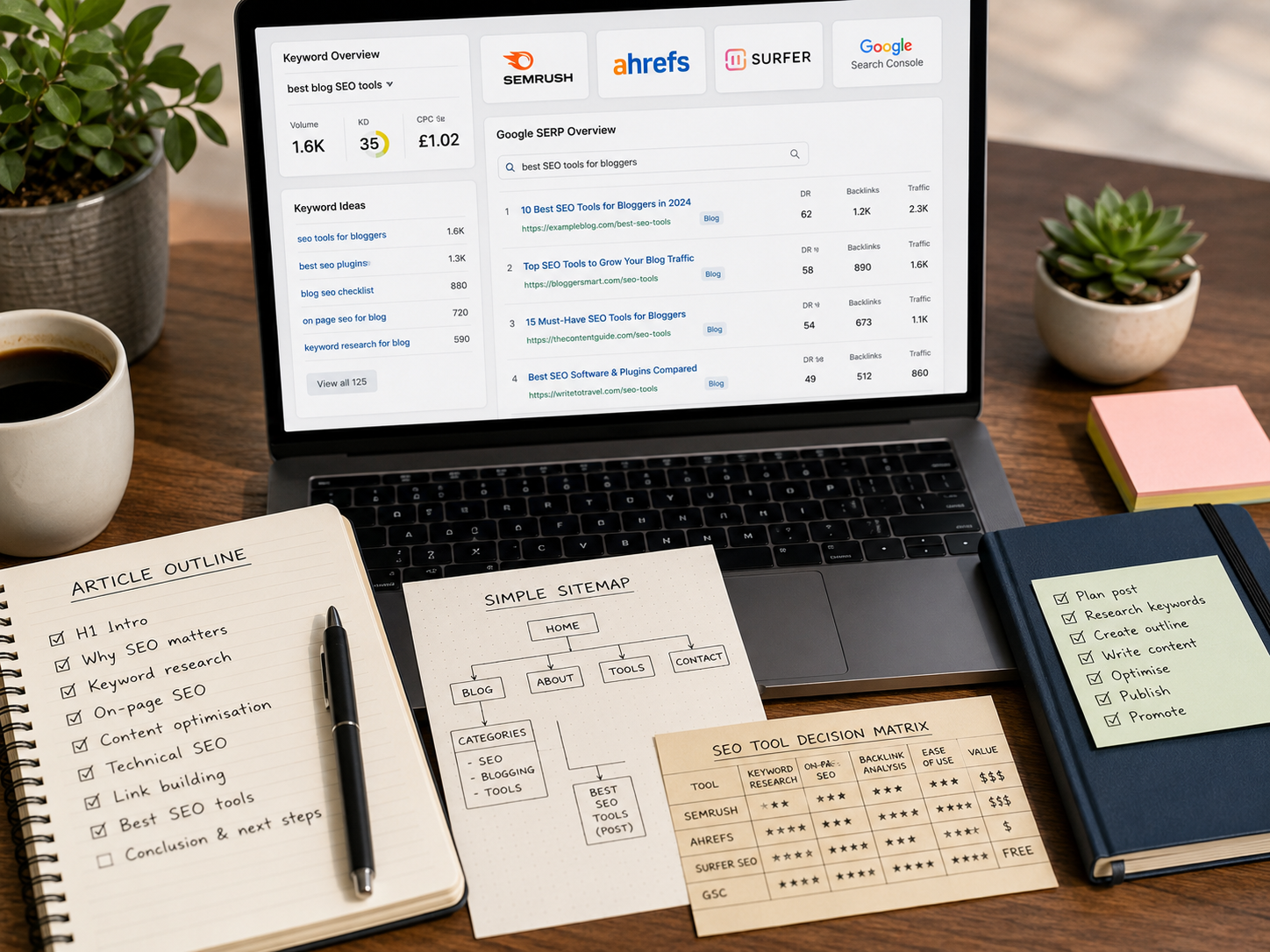
Free tools are enough when you are confirming indexing, researching early topics, understanding seasonality, and building a publishing routine. At this stage, the missing ingredient is rarely a more expensive graph.
Pay When Data Changes Decisions

Paid tools earn their place when they help choose better topics, expose competitor gaps, find backlink opportunities, prioritise updates, or diagnose technical problems. If the reports do not change what you do next, the subscription is mostly decorative.
Count The Time Cost

The real cost includes learning the platform, maintaining projects, reviewing alerts, and acting on reports. A simpler tool you understand may provide more value than a powerful suite you open twice before quietly forgetting the password.
Review The Stack Regularly

A new blog needs discovery and publishing support. A mature archive may need audits, pruning, internal linking, and decline monitoring. Cancel tools that duplicate another service or solve a problem you no longer have.
Final Recommendations
Every blogger should begin with Google Search Console. Add Google Trends for changes in interest and Keyword Planner for extra ideas. Choose Ubersuggest for a beginner-friendly paid step, or RankIQ when content planning is the main obstacle.
Semrush is the strongest all-round serious platform. Ahrefs is the better fit for backlinks, competitor pages, and keyword exploration. SE Ranking offers strong value for tracking and audits, while Surfer and Clearscope suit increasingly structured content operations.
Broader creator setup: Creator Tech Stack Explained
Pros And Cons Of SEO Tools
Pros
Cons
SEO Tools And Digital Clutter
Give Every Tool One Job

Decide which platform handles performance, research, optimisation, and tracking. When several tools report similar information slightly differently, you gain more notifications rather than more clarity. A smaller stack makes it easier to act.
Protect Your Writing Time

Schedule research and reporting instead of checking dashboards throughout the day. SEO software should help you publish and improve useful work. It should not turn your desk into a control room where every coloured arrow feels like a minor emergency.
Wellness perspective: Digital Clutter And Mental Load When Working From Home
FAQs
What is the best SEO tool for bloggers?
Google Search Console is the best starting point because it is free and shows real visibility, query, click, impression, and indexing information. Growing blogs may add Semrush, Ahrefs, SE Ranking, RankIQ, Surfer SEO, Clearscope, or Ubersuggest according to the problem they need to solve.
What is the best free SEO tool for beginners?
Google Search Console is the strongest free starting tool. Pair it with Google Trends for search-interest patterns and Google Keyword Planner for additional topic ideas.
Do bloggers need paid SEO tools?
Not immediately. Paid tools become worthwhile when competitor research, backlink analysis, rank tracking, technical auditing, or content optimisation can materially improve your next decision.
Is Semrush or Ahrefs better for bloggers?
Semrush is better for bloggers wanting broad all-round coverage. Ahrefs is better when backlinks, competitor pages, and deeper keyword exploration are the priority.
Which SEO tool is best for keyword research?
Ahrefs and Semrush provide the strongest serious research options in this group. Ubersuggest is easier for beginners, while Google Trends and Keyword Planner offer a useful free starting combination.
Final Verdict
Best SEO Tools For Bloggers Verdict
The best SEO tool is the one that removes your current bottleneck. New bloggers should start with Google Search Console, Google Trends, and Keyword Planner. Growing bloggers can add Ubersuggest or RankIQ for simpler research and content direction. Established sites may justify broader platforms for competitors, backlinks, audits, rankings, and large-scale updates.
Choose Semrush for the strongest all-round package, Ahrefs for deeper competitor and backlink exploration, SE Ranking for tracking and audits, RankIQ for blogger-focused planning, Surfer for active content optimisation, and Clearscope for structured content teams.
Before subscribing, write down the exact decision the tool must improve. If you cannot name that decision, you probably do not need the tool yet.


